Is Mandahl Fished Out? A Final Look at the First 10 Days 2021 Report

Last week we looked briefly at increased bird concentration among Mandahl’s Mangrove and if that signaled changes occurring in the Eco-system. In essence, we speculated that the movement of birds such as herons and pelicans were a strong indicator of where bait fish were concentrating in Mandahl.
This factor is well known among fishermen … where sea birds flock, fish run amok.
Yet while bird presence may indicate an available aggregation of fish they feed upon, does this behavior also give clues to fish abundance? In the open ocean, a flock of a dozen or more sea birds can indicate 1,000 fish or 100,000 fish. The ocean is just too vast and deep for birds to tell us how many fish are there.
However, in an ocean wetland nursery habitat such as Mandahl Bay pin-pointing exactly where birds are, combined with other environmental clues, may be able to tell us when periods of low fish presence will occur.
The region is an enclosed habitat, protected from the ravages of the Atlantic ocean, that maintains single channel access for marine life and boaters. It serves as a migratory stop, a refueling station, a breeding and birthing arena, and as rest and recovery port for a multitude of various lifeforms. Shallow waters make decent ocean-side underwater observation possible and advancing aerial drone imagery by Danet Operations Group is giving us first-peeks into life in even the thick algae-greened back lagoon waters. Thus, being a fairly small Eco-system, we can monitor Mandahl and draw some conclusions regarding wildlife behavior and how it adopts in advance of ‘low-prey’ conditions.
But that’s a subject to be detailed in a much more comprehensive manuscript of our research at Mandahl. For now, the graphed image below indicates how Heron and Egret behavior signaled that Mandahl might be entering a period of “Bait-Fish Drought”.

The birds were also reacting to a number of other events in the environment, many of which we have monitored to the best of our ability. These are things like temperature (air and water), water turbidity, rainfall and run-off events, greening/browning of plant life, other wildlife presence, human uses, etc. etc. Yeah, it gets complicated and sometimes one feels one’s head might explode!
What the whole Tri-Domain Real-time Mapping Project hopefully will do is translate that learned ‘instinct’ some of us have about the environment into a quantifiable resource. Mandahl, and similar areas, do not follow annual calendars or seasons for a lot of its events. Life-cycles move around and among seasons. Some are governed by the moon, some by sun. Some by the amount of oxygen present in the water, others by how much decaying detritus reached them through natural run-off filter regions. The many permutations of these events interacting at different times and strengths can be viewed almost as random ripples in a pond that merge and grow into either a beneficial or harmful effect. It is difficult to know what individual ripples will do, but observation over time begins to show definitive patterns. It was clear by mid-October, that Mandahl would be in for a slow new year bait-fish-wise and, as a result, bird migration-wise.
Autumnal Equinox Aerial drone footage showed that while there were enough fish in the pond for bait-fishing activities to occur easily, the large schools were in steady decline. Seasonal rainfall was delayed and with it the Fall greening of the Eco-system. The Water table in the hillside would continue to drain into the marshes, sustaining plant growth. But there would be no sudden burst of flowering this October/November, meaning that their subsequent entry into the decay cycle feeding the bay would be late.
Fish presence continued to decline, now pushing the wading herons away from their former ‘easy-pickings’ sand flats. By the first ten-days of 2021, the herons had retreated into the back areas of the lagoon. These areas are harder-work feeding areas for many herons, especially the larger ones. They have to balance for long minutes (30+ has been observed) on a branch or root hoping for a hidden fish to poke its nose out.
Brown Pelicans also no longer frequent the center of the lagoon. Flocks of a dozen or more pelicans may fly in, but are gone within the hour as fish-pickings are slim. Pelican dives are from the few that have not abandoned the area. They plunge closer and closer to the Mangrove root line.
These behaviors should be a signal to commercial and recreational fisherpersons alike, that Mandahl is going through its cycles and is in a needed state of natural nursery habitat recovery. If nets have to be cast into mangrove roots to obtain bait-fish, that is a signal to stop.
We cannot determine if the bait-fish decline is as a result of human fishing activity or simply seasonal. What we do know that currently bait fish presence is well below average and that the remaining fish need time left alone to reproduce and repopulate the area.
Voluntary suspension of bait-fishing for a month, or at least until the birds say “Go”, seems to me to be a smart way of maintaining the commercial and recreational fishing viability of Mandahl as a wildlife Eco-system we can all enjoy.
+ + + + + + + +
As a Reminder:
The Camp Umoja facility remains closed to camping as Hurricanes Maria & Irma renovations continue. Eco-system tours also are suspended until after the COVID-19 crisis is under control.
Our RESEARCH, LITTER CLEAN-UPS AND OBSERVATIONS CONTINUE.
Help us by becoming a Tier Patron today. You can support the environmental education efforts of Djabana’s Kuumba Campgrounds, Inc., a Virgin Islands registered non-profit. Your help supports DKC Inc. programs such as: the Camp Umoja Non-profit Eco-Learning Center, the Environmental Rangers Youth Group and wildlife library website ClimateChangeVI.org. Become a Tier Patron! We would really, really appreciate it! : ) https://www.patreon.com/climatechangevi
+ + + + + + + +

CALL OF THE KINGBIRD
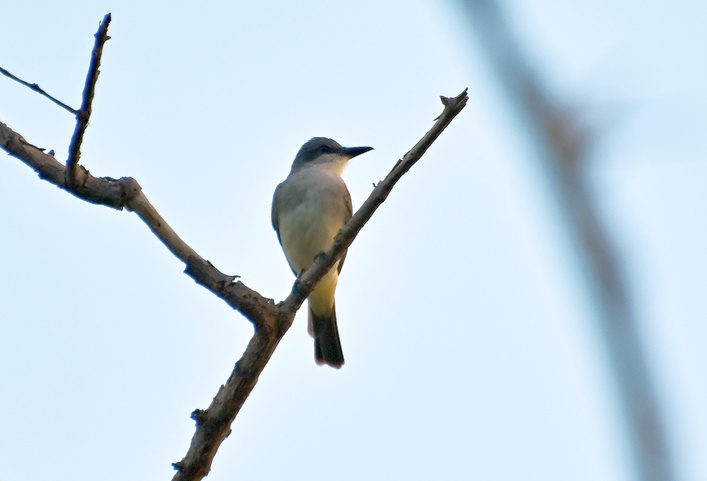
Do you know the Gray Kingbird?
Tyrannus dominicensis, as it is affectionately called in the scientific community, is a medium-sized bird that can be categorized as a ‘Flycatcher”. It uses its all-purpose beak to snag insects as tiny as flying ants and termites, up to roaches, beetles, grasshoppers and even the occasional lizard.
Beak-to-tail, adults can range from 9 inches to 16 inches in size. They naturally reside in wetlands areas like swamps, marshes and mangrove lagoons, as well as coastal vegetation and woodlands. On St. Thomas, they can pretty much be found island-wide. Around homes and town, they dot electrical lines, occasionally flying about in short, circular flutters or hovering while they snag insects.
In the wild, locate them perched on tree-tops or snags (bare branches and twigs). In neighborhoods, look around utility poles, especially those with street lights. Although this bird is a day feeder, it has changed its habits to now hunt while street lights are on. Insects are attracted to the lights and Gray kingbirds find lampposts to be fast food buffets. If you swear you hear songbirds at night, you probably are not dreaming. Day or night, Gray kingbirds sing while feasting!
For your edification, I have attached an audio file of two Gray kingbirds. The loud bird is perched above me in a tree. The bird heard twittering continuously in the distance, is also a Gray kingbird. That bird is about 150 feet away, chirping gloriously while it dives in loops and circles through a swarm of tiny insects. (The crowing is obviously a rooster … lol … we just cannot avoid them on STT)!

——
Lastly … if you are a patron, check your in box! I did up two slideshows of last week’s pics and set them to some hopefully inspirational music.
——-
Next Week:
By request, we’ll attempt camera penetration of the dark and brackish back lagoon waters of Mandahl Bay in search of ‘low-season’ fish presence.
: ) See you then!
~ Karl Callwood