MANDAHL 2021: “First 10 Days Report” – Public Edition
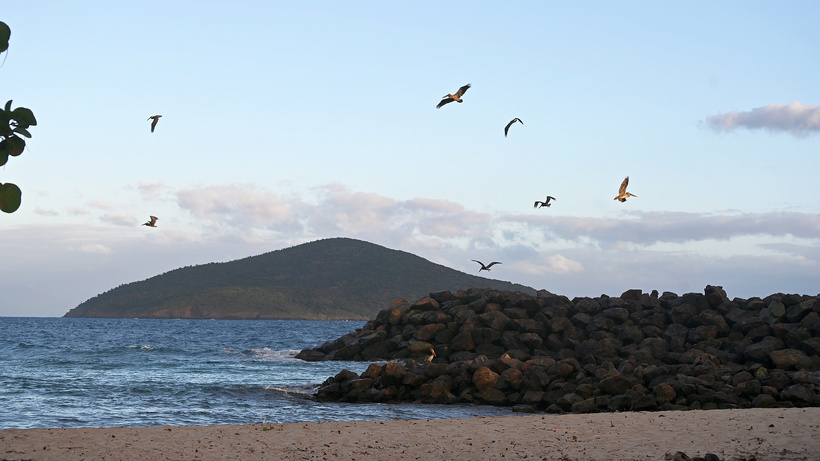
I’ve decided today to dose you with picture examples of my first 10 days assessment of the Mandahl Bay Area of Particular Concern and Area for Preservation and Restoration (APC/APR), St. Thomas, Virgin Islands.
In continuing my quest to understand how the Mandahl Eco-system functions and evolves I have turned to birds – their count and identification – as the final stage in development of “A Tri-Domain Methodology for Establishing Reliable Real-time Life Counts in Visibility-Challenged Wetland Eco-Systems”.

Yeah, we’ll get to dissecting that mouthful in future posts. It means I am coordinating the Camp Umoja Non-profit Eco-Learning Center’s submarine, land and aerial observations of Mandahl over-time to try and create a predictive model for future wildlife presence and behavior.
So, I will chat just a little about how observed bird behavior changed during a late seasonal transition from record high 2020 Summer and Fall temperatures to chilly gusting winds during a multi-day Winter storm over the 2021 New Year’s holidays.
Most adult ‘sprat’ or ‘shad’ had over-populated the Mandahl arena by late-fall and our quarterly aerial reconnaissance drone images by Vince Danet during the 2020 Winter Solstice period confirmed a lower apparent small-fish life presence in the pond middle and channel runs. Algae greening had coated the rear-most lagoon and flights recorded less small silvery fish splashing.

What was significant in the Winter Solstice flight was rough ocean waters as a trans-Caribbean cold front developed over us. It would bring strong winds and tropical-storm speed gusts (although it was NOT a tropical storm).
In advance of the maelstrom, the drone flight observed several large turtles swimming to exit Mandahl and others already in deeper Atlantic waters. White Mullet circles were absent, although disjointed small schools formed erratic lines or bunches near shore-edge roaming tarpon.

The tarpon mostly stuck to the shallows and Red Mangrove root lines searching for well-hidden fish … although aerial drone footage in the same time period captured an exceptionally large school of tarpon charging through the rough waves out by the Atlantic Ocean western rocks.
Could that second batch of tarpon be chasing sprat and fry already evacuating the Mandahl arena in advance of bad weather? We will look more carefully at that in a future post.
For now, I would like you to look at the variety of bird images I have included above. They were all taken within the first 11 days of 2021. They indicate presence, and not so much amounts nor always behavior in mere photographs. I use there as “Presence Images” a/k/a “Proof-of-Life”. Other notes document exactly where in the Eco-system each bird is aggregating. As simple a concept as this is, it does relay to me where small fry and sprat are, even when the area appears to be in ‘fish drought’.
NOTE: Patrons at all tiers get the same images without watermark! Search your patron-only stream for the article titled “Mandahl 2021 “First Ten Days Report” – Patron-Only Images”
In the dawning days of the New Year and the aftermath of cool and very gusty winds, I found that most resident wading bird life had moved to the extreme rear of the lagoon. The number of Little Blue Herons and Green Herons had visibly increased, poking sharp bills into the water around red mangrove root waterlines. Their strikes were more frequent than normal and most often coming up with a sprat or fry in beak. A more heron-crowded low-fish Eco-system meant that many birds were also becoming bold and perching out in the open on moored fishing boats. At any time a fishing boat could come in and present nice bait-raiding targets for the birds.
Several inter-species fights were witnessed as new herons ignorantly perched in territorial hunting spots of resident herons. Green Herons tended to be particularly aggressive towards new heron arrivals.

Small silvery fish life (Fry, Shad/Scad & Sprat) in the mid-lagoon had migrated out to the deep ocean, but a significant number of adults chose to remain among the dense Mangrove roots for protection. For just a couple of days, pelican numbers at Mandahl increased drastically, with days witnessing a dozen or more diving while that many or more rested in trees. But sprat were scarce at the moment in the preferred deeper diving spots of the pelicans. They smacked into the water closer and closer to where red mangrove roots arched majestically into brackish water.
Dive after dive netted the Pelicans little to no reward and the flocks left, presumably to find better hunting elsewhere around this close chain of Virgin Islands.
Meanwhile, heron presence and activity was increasing among shoreline mangrove roots. There were now new heron arrivals in the Eco-system. These birds are specialists in waiting for a small fish to poke its nose out from under a mangrove root, fallen branch or rock crevice. They strike like lightning and, standing still as statues, are masters of conserving energy between feeding opportunities.

Tarpon and snook during this time also typically skirt red mangrove roots and are not as much out in the center areas of the lagoon. Food is not as easy to catch now for these hungry fish and recreational fishermen flock to Mandahl for easy catch-and-release game fishing from shore. This activity has created an increase ghost gear entanglement problems, as I accounted in this post of January 8, 2021: “The Brown Pelican’t and the Ghost Gear of Christmas Past”.
I will give you a day or two to digest this post and the ghost gear post, then come back at you with details on how those bird pictures help me count fish presence at Mandahl! There are a few little peeps-behavior pet peeves I will get into in my next post as well. Some Mandahl users are still acting out of disrespect for the area environment, but overall cleanliness seems to be improving … for now. Litter tends to rise and fall with seasons and randomly occurring party events.
Remember to “Follow” us here on Patreon, if you have not already done so. Following is free and my Patreon Followers and Patrons always get first alerts of my posts. 🙂
If you find you like our digital presentations the Eco-system and can afford to help us continue, your paid Patronage at any tier level will go a long ways towards keeping our work going.
See our funding tiers here: https://www.Patreon.com/ClimateChangeVI
If you are already a Patron, many many thanks as always and I hope you enjoy today’s unwatermarked images just for Patrons.
Please remain COVID safe!
~ Karl Callwood